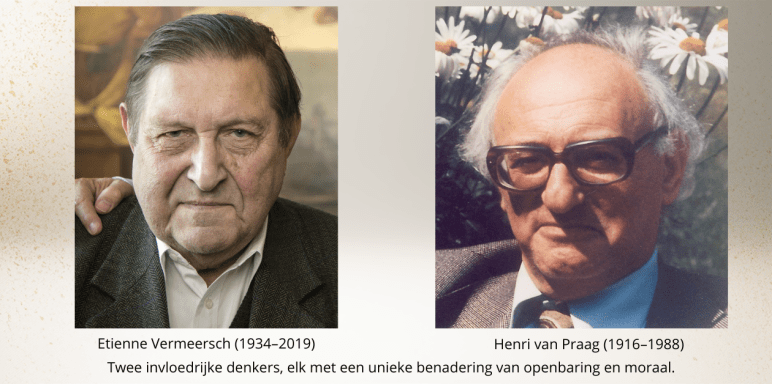
In a widely circulated English-language video, the Belgian philosopher Etienne Vermeersch argues that the mere fact of slavery is sufficient to dismiss both Christian and Islamic revelation as man-made. His reasoning is straightforward and, at first glance, compelling: if God had truly revealed himself, that revelation would have condemned slavery immediately and unequivocally. Since this did not happen—on the contrary, slavery was religiously justified for centuries—there can, according to Vermeersch, be no question of divine revelation.
The argument is sharp, morally charged, and resonates with contemporary sensitivities surrounding colonialism and Western oppression. Yet it rests on an assumption that is rarely made explicit: a very specific understanding of what revelation ought to be.
It is precisely at this point that Henri van Praag, in his 1951 essay The Traces of Israel in the West, offers a fundamentally different perspective.
A Static versus a Historical Understanding of Revelation
Vermeersch implicitly adopts a static model of revelation:
- revelation is a timeless moral code,
- given once and for all,
- immediately applicable,
- and morally transparent according to contemporary standards.
Within this framework, his conclusion is logical: no explicit prohibition of slavery means no revelation.
Van Praag thinks in radically different terms. In his analysis, revelation is not a moral end point but a historical learning process. It is not a ready-made ethical system, but a path along which human beings gradually come to understand what human dignity entails—often in tension with the stubborn realities of their own social and economic structures.
From this perspective, slavery is not evidence against revelation, but a touchstone: does the biblical tradition, historically speaking, generate a movement away from slavery or not?
Van Praag believes it does—and this can be shown clearly through three historical moments.
Three Historical Moments
1. Philo of Alexandria: Slavery Made Un-Natural
In the first century of the Common Era lived Philo of Alexandria, a Jewish thinker in the Greco-Roman world. Slavery was then a self-evident foundation of society. Aristotle had even given it philosophical legitimacy: some people, he claimed, were slaves “by nature.”
Philo broke with this framework through a simple but radical assertion: no one is born a slave; all human beings are free by nature.
He did not call for the immediate abolition of slavery—such a demand would have been historically inconceivable—but he stripped slavery of its natural justification. It was no longer understood as part of the created order, but as the result of human power relations.
This shift is decisive. Where slavery loses its self-evidence, it becomes morally problematic. No law is enacted here, but a moral principle is articulated whose full consequences will only emerge much later.
Ironically, Vermeersch himself appeals to Philo. In doing so, he employs a fruit of the biblical moral process against the very tree from which it grew.
2. Jacob van Maerlant: Inequality Becomes a Question
In the thirteenth century, the Christian poet Jacob van Maerlant posed a question that seems simple at first glance, but was explosive in its context: Why are human beings born unequal, if they all descend from Adam?
The feudal order was deeply entrenched. Lords and serfs were taken for granted. Yet within the biblical creation narrative—one origin, one humanity—this order began to creak.
Van Maerlant was no revolutionary. He did not abolish systems. But he articulated a tension that is scarcely imaginable without the biblical tradition: how can fundamental equality coexist with structural inequality?
What happens here is crucial to Van Praag’s argument. Revelation does not work through immediate decrees, but by morally problematizing what was once self-evident.
3. Wilberforce and Rothschild: The Moment of Irreversibility
The third step in this process occurs in the nineteenth century, when slavery is not only morally contested but also legally abolished. In the British Empire, this took place with the Slavery Abolition Act of 1833, through which a world power declared slavery as an institution unacceptable.
The moral and political driving force behind this development was William Wilberforce, who, inspired by deeply held Christian convictions, devoted decades to the abolition of first the slave trade and then slavery itself. Yet moral insight alone was insufficient. To make abolition executable, the government adopted a controversial but effective solution: slaveholders were financially compensated.
A central role in this operation was played by Nathan Mayer Rothschild, not as a benefactor drawing on personal wealth, but as the financial architect of the state loan. Through a syndicate he organized, the bulk of the loan was underwritten and placed on the market, ensuring that the state had access to the necessary funds.
As Van Praag emphasizes, the significance of this approach is pragmatic: abolition became practically possible not because revelation suddenly pronounced something new, but because it had worked long enough on the moral consciousness of society for its consequences to be realized historically.
What Vermeersch Misses
Vermeersch is right in stating that slavery was religiously legitimized for centuries. This cannot and should not be glossed over. But the conclusion he draws from this fact holds only if revelation is understood as a static moral handbook.
Van Praag shows something else: the biblical tradition does not legitimize slavery as an ideal, but undermines it over the long term. It deprives slavery of its natural status, renders it morally problematic, and contributes to a historical development in which slavery ultimately becomes unacceptable.
What Vermeersch interprets as the failure of revelation appears, in this reading, as its historical efficacy.
Conclusion: Why This Matters Today
In a time when religion is often portrayed as an obstacle to emancipation, this distinction is crucial. Not every religious posture is liberating. But neither is every form of emancipation conceivable without the moral heritage of the biblical tradition.
Slavery is not a side issue here, but a litmus test. It shows that moral insight does not arise out of nothing, but grows—slowly, conflict-ridden, historically.
Recognizing this makes it possible today to reopen the conversation between believers and secular thinkers, not by overwhelming one another with absolute claims, but by attending to the long road along which moral truth unfolds.
Reference
[1] In de Waagschaal (Dutch theological journal), 1951
 Midrashram